

The quality of day-to-day management is one of the strongest determinants of how people experience work. Across Aistii data, better manager quality is consistently linked to outcomes organisations care about most: meaningful work, work-life balance, lower burnout risk and stronger productivity.
The more important question is not whether manager quality matters. It does. The real question is: how do you measure it in a way that is concrete, reliable and actionable?
How We Measure Manager Quality
Aistii measures manager quality through specific employee-reported behaviours drawn from a broader set of leadership indicators. Three behaviours in particular form a reliable composite of overall manager quality:
- I receive enough encouraging and constructive feedback from my manager
- I receive support and help from my manager when needed
- My manager encourages me to share my views on how our work should be done
Together, these behaviours capture three core dimensions of effective management: developing people, providing support and creating room for employee voice. Based on the composite score, manager quality is divided into four quartiles, from lowest to highest.
What the Data Shows
Across nearly 10,000 employees, the relationship between manager quality and employee outcomes is both strong and consistent.
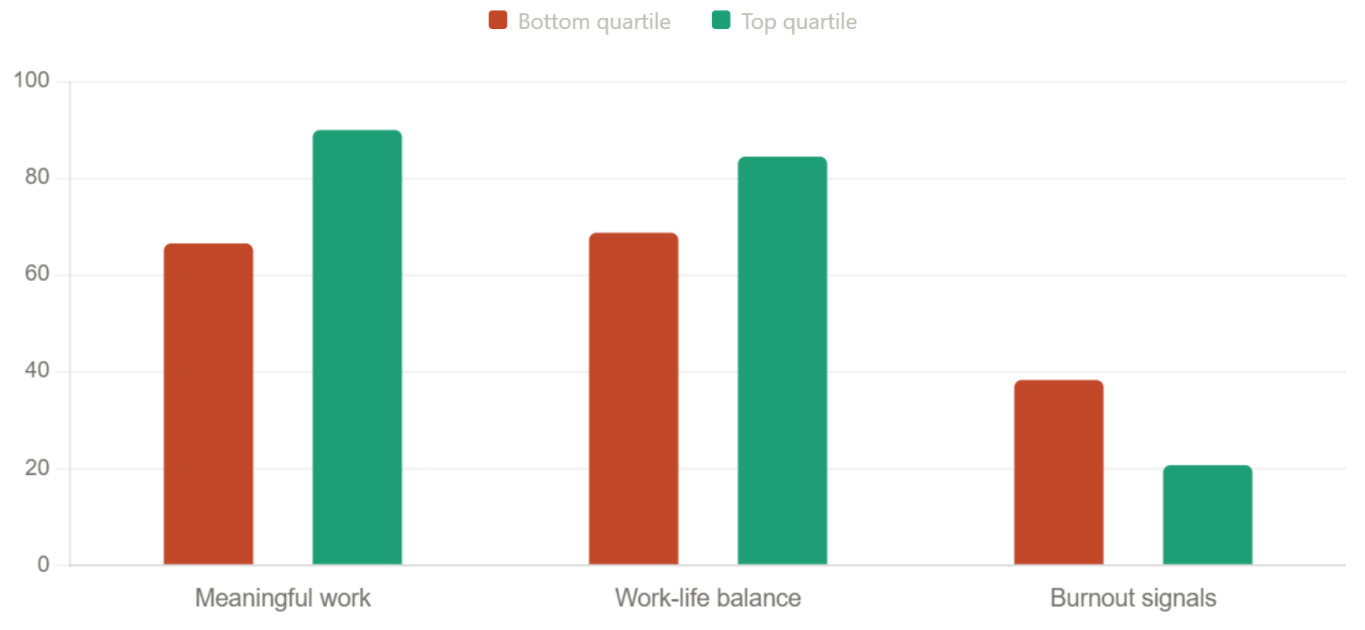
Compared with employees in the lowest quartile, employees with top-quartile managers report:
- 35% higher meaningful work
- 23% better work-life balance
- 48% lower burnout signals
What makes this especially compelling is that the improvement is not limited to the extremes. At each step up in manager quality, these outcomes improve. Better management is consistently associated with a better employee experience. The same pattern appears in productivity.
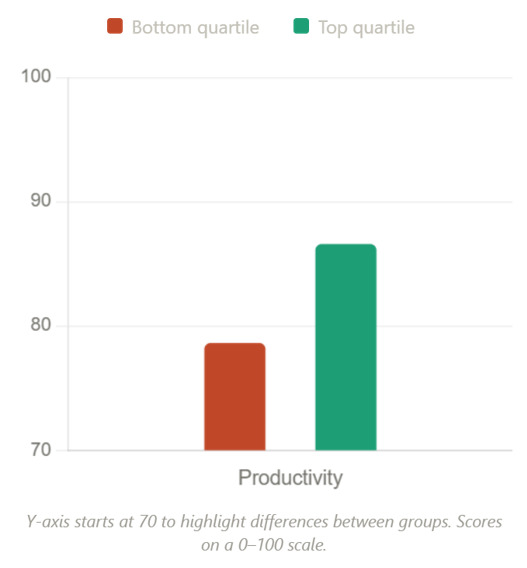
When manager behaviour scores are compared with productivity — a composite measure covering both the quantity and quality of work completed — employees in the top quartile score 10% higher than those in the bottom quartile. And again, the gains increase steadily from one quartile to the next.
In practice, that difference compounds across teams. It represents a meaningful and recoverable gap in output — one that organisations can reduce through better management.
Why This Matters
Manager quality is not a soft or abstract concept. It is a measurable driver of both employee experience and productivity, with clear and predictable consequences.
When organisations assess management quality systematically, they can act with much greater precision. They do not have to assume which managers need support. They can see it in the data. They do not have to guess where leadership gaps exist. They can identify them clearly and respond.
That is the value Aistii provides: clear visibility into the quality of everyday leadership, and a concrete basis for action.